Tic-tac-toe (noughts and crosses in the UK) is often a child’s first real strategy game. It needs nothing but a pencil, the rules fit in one sentence, and a game lasts a minute. This guide covers the rules, a handful of simple ways to win, why so many games end in a tie, and what to play when ties get boring.
The rules
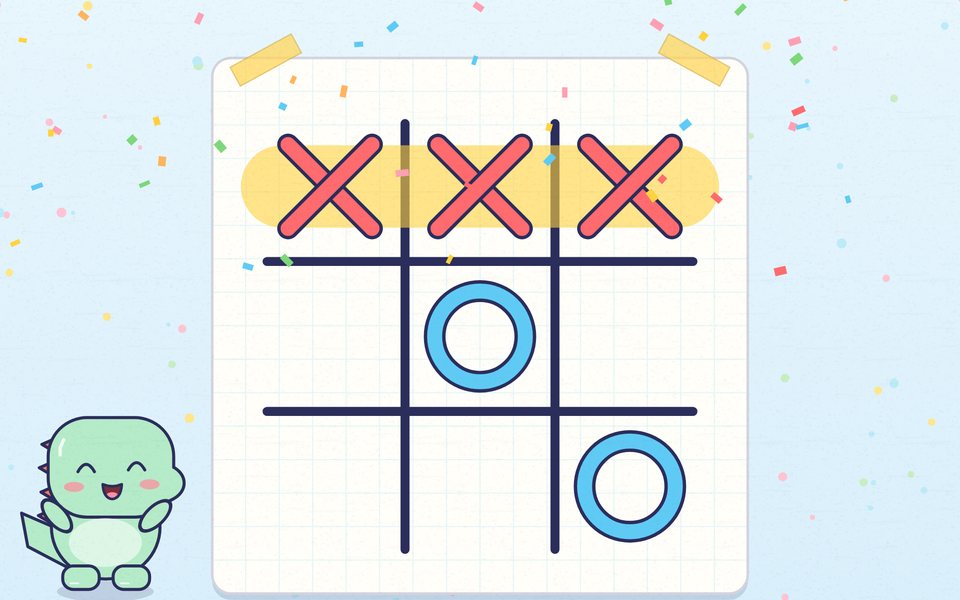
Two players take turns drawing their mark, X or O, in an empty square of a 3 by 3 grid. The first to get three in a row wins: across, down or corner to corner. If all nine squares fill up with no line of three, the game is a tie.
There are eight ways to make a line: three rows, three columns and two slanted lines through the middle. Show your child all eight before the first game. It helps them see what they’re looking for.
Going first is an advantage, so take turns starting. In our tic-tac-toe game, whoever starts swaps every game, against Doodle or a friend.
Simple ways to win
These tips build on each other. Teach one at a time, starting at the top.
1. Win if you can
Before every move, look for two of your own marks in a line with the third square empty. If you find one, put your mark there and win. It sounds obvious, but young children often miss it because they’re busy with their own plan.
2. Block if you must
Next, look at the other player’s marks the same way. If they have two in a line and the third square is empty, put your mark there. Saying it out loud helps: “Does Doodle have two in a row anywhere?”
3. Take the middle, or a corner
The middle square is part of four lines: a row, a column and both slanted lines. Each corner is part of three. The squares in the middle of the edges are part of only two. So the middle is the strongest first move, and a corner is next best.
4. Make a fork
A fork is one move that makes two lines of two at the same time. The other player can block only one of them, so you win with the other. Here’s one to try. Say you’re X:
- Put your X in the top-left corner.
- The other player puts an O right next to it, in the top middle.
- Take the middle square. Now you have two in a line, corner to corner, so they must block the bottom-right corner.
- Put your X in the bottom-left corner.
Now you can win two ways: down the left side, or along the slanted line from the bottom-left to the top-right. They can only stop one.
5. Stop forks before they start
Forks work because of the very first moves. If the other player starts in a corner, take the middle: any other square lets a careful player force a win. If they start in the middle, take a corner, because the edge squares lose the same way. These two rules are worth learning once your child is good at winning and blocking.
Why so many games end in a tie
When both players make no mistakes, tic-tac-toe always ends in a tie. People worked this out long ago, and computers have checked every possible game (there are 255,168 of them). So you don’t win tic-tac-toe by being clever on your own. You win by spotting the other player’s mistake.
That’s worth saying to a child who’s upset about a tie: a tie means you both played well. In our game, Doodle cheers either way, and a tie gets a “High five!”
Doodle’s three levels follow the same idea:
- Easy: he often misses a win or forgets to block, and sometimes plays a silly move. Young players win a lot.
- Medium: he takes every win and blocks every line of two, so the surest way to beat him is a fork.
- Hard: he plays every move perfectly. The best anyone can do is a tie, every time.
Playing with a young child
- Keep it short and kind. At 4 or 5, let your child go first and point out their chances: “Look, you have two in a row!”
- Think out loud. Say why you’re making your own moves: “I’m putting my O here so you can’t get three.”
- Allow a take-back. On paper, an eraser does it. In the game, the take-back button undoes a move, and the light bulb shows a good one.
- Play each other. Pick “A friend” on the start card and two children can play on one screen.
- Go back to paper. The tic-tac-toe page prints six blank boards on one page, enough for a best of six.
Moving up: four in a row, then caro
When every game ends in a tie, make the board bigger. The same game goes up two steps. Four in a row on a 6 by 6 board gives more room to plan, and it suits many 5- and 6-year-olds. Caro is five in a row on a big board, and it’s a real game for 7- and 8-year-olds and for grown-ups.
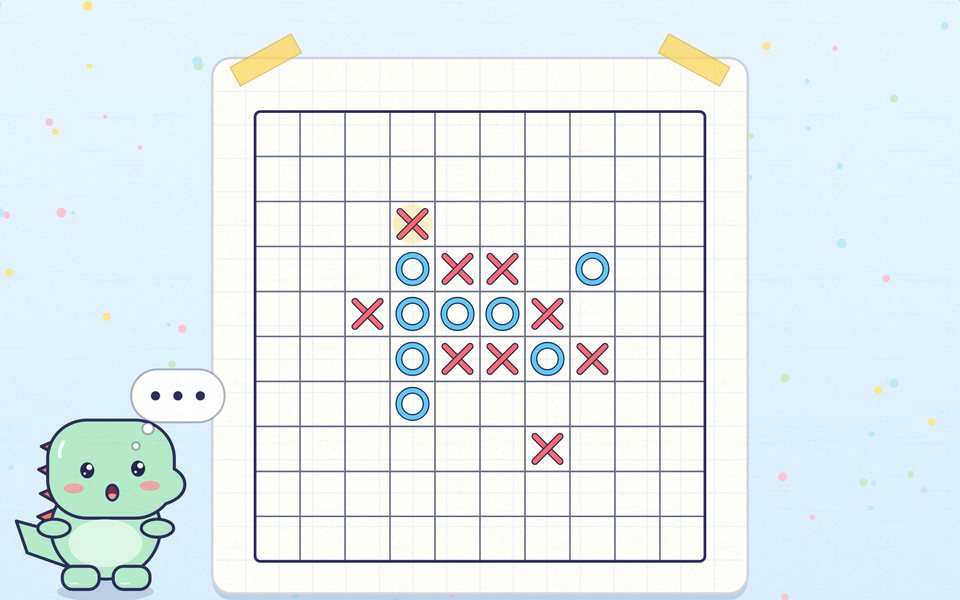
Caro (cờ caro) is the five in a row game children in Vietnam play on squared notebook paper, from the same family as gomoku. On a big board, ties are rare, and a few new ideas matter:
- Start near the middle. More lines run through the middle squares than through the edges.
- Watch for open threes. Three in a row with an empty square at each end is a threat. When the other player has one, block it right away.
- Block a four at once. Four in a line with an empty square to finish it wins on the next move.
- Make two threats at once. It’s the fork from tic-tac-toe again, and it’s how most games are won.
Some players use a rule that five in a row doesn’t count if the other player’s marks block both ends. Our game leaves that rule out to keep it simple: any five in a row wins. The game goes back onto paper too: the caro page prints a 10 by 10 board like the one on screen and a big 15 by 15 board, and the tic-tac-toe page prints a 6 by 6 board for four in a row.
Like puzzles that use a pencil? Try our guides to printable mazes and dot to dot counting.