Caro (cờ caro) is the five in a row game children in Vietnam play on squared notebook paper, from the same family as gomoku. When tic-tac-toe keeps ending in a tie, it’s the next step. Here are the rules, the ideas good players use and how to beat Doodle. For three in a row and forks, see our tic-tac-toe guide.
The rules
Players take turns putting their mark in any empty square. The first to make an unbroken line of their own marks wins: across, down or slanted. A full board with no line is a tie, but on a big board that’s rare.
Our caro game has three boards, so a child can grow into the full game:
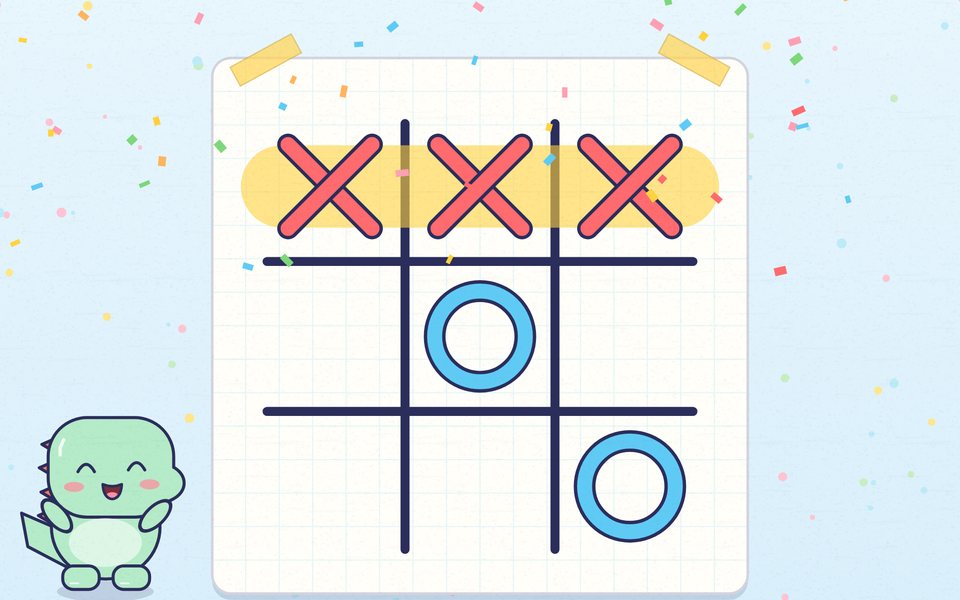
- 3 in a row on a 3 by 3 board. This is tic-tac-toe, from about age 4.
- 4 in a row on a 6 by 6 board. More room to plan, and a good step for ages 5 and 6.
- 5 in a row on a 10 by 10 board. Real caro, for ages 7 and 8 and for grown-ups.
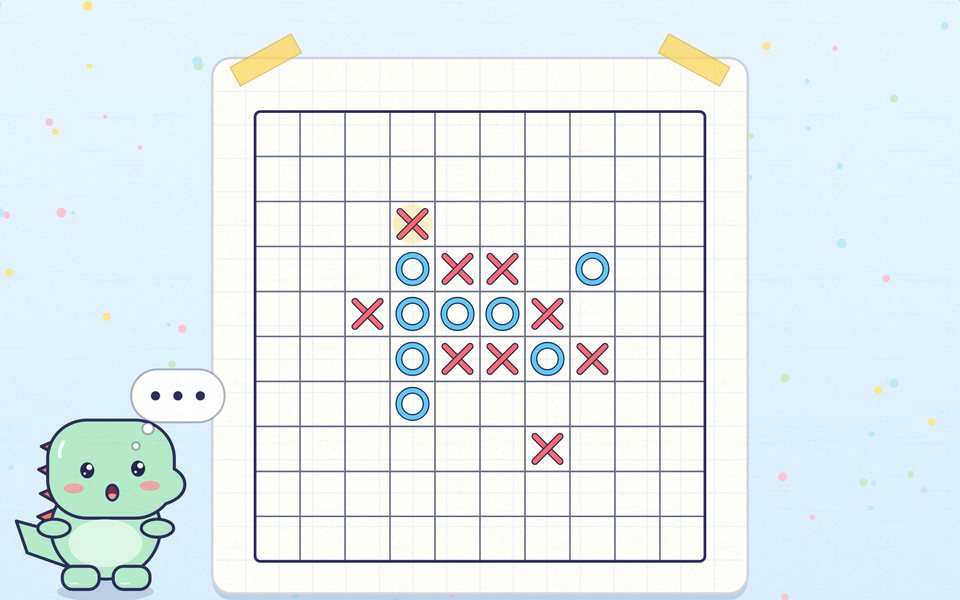
On screen, you’re the red X, and Doodle or a friend is the blue O. Rules on paper vary: some players say a five blocked at both ends doesn’t win, and some say only exactly five wins. Our game keeps it simple: any five or more wins. The caro page prints a 10 by 10 board like the one on screen and a bigger 15 by 15 board.
Words caro players use
Say you’re X:
- A four is four X marks in a line with one empty square that would make five. The other player must block that square at once.
- An open four is four in a row with both ends empty. Two squares would make five, and only one can be blocked, so an open four wins.
- An open three is three in a row with an empty square at each end. If nobody stops it, your next move makes an open four. A three with a gap, like X X _ X, with both ends empty, is just as dangerous.
- A closed three has one end blocked, by an O or the board’s edge. Its four can be blocked, so it’s much less dangerous.
- A double is one move that makes two threats at once, such as two fours, or a four and an open three. Blocking one leaves the other. It’s caro’s version of the fork in tic-tac-toe.
Opening ideas
- Start in the middle. More lines pass through the middle squares than the edges. On the bigger boards, Doodle always starts in the middle.
- Play close. Put your next mark touching your first, or one square away. Marks far apart rarely end up in the same line.
- Going second? Play next to the first mark. An O touching the X, straight or slanted, starts getting in its way at once.
- The edge is a wall. A line against the edge is blocked at that end, so build where both ends have room.
Attack and block
Before every move, run through this checklist, out loud with a young player:
- Can I make five? Then do it.
- Does the other player have a four? Block its empty square now.
- Can I make an open four, or a double? That wins the game.
- Does the other player have an open three? Block one end before it becomes an open four. If it has a gap, like O O _ O, put your mark in the gap.
- Otherwise, build. Make a three of your own, ideally one that also gets in the other player’s way.
The best moves do two jobs, blocking a three and starting a line of your own. A four of your own buys time, because it must be answered first. Strong players win with a run of fours: four after four, each forcing a block, until one is a double.
Why the first move matters
Going first is a big advantage in five in a row. On a 15 by 15 board, Victor Allis and his colleagues showed in the early 1990s that the first player can always win with perfect play (a summary with the references). Professional players use a version called renju, with extra rules for the first player only: for example, they may not make two open threes with one move.
Tournament players also use swap openings. In one of them, the swap rule, one player draws three marks, two X and one O, and the other then chooses to be X or O. It’s a fair way for an older and a younger child to play.
At home, the easy fix is to take turns going first, and our game does it for you: after each game, the other player starts. Starting second is usually the harder job.
Playing Doodle, or a friend
Doodle has three levels:
- Easy: he often misses a win or forgets to block, and makes silly moves, so little ones win often.
- Medium: he never misses a win or a block, and he plays a double when he finds one. To beat him, make your own double first.
- Hard: he also stops your threes before they grow, and looks ahead for a run of fours that wins. Beating him takes real planning.
There’s no timer. The light bulb shows a good move (the one Doodle would play on Hard), and the take-back button undoes your last move along with Doodle’s answer.
To play a friend, pick “A friend” on the start card and take turns on one screen. X starts the first game, the players swap after that, and the score is kept until you change the board.
Playing with a young child
- Start on 4 in a row. The 6 by 6 board teaches fours and blocking on a board small enough to see at a glance.
- Check the slanted lines on purpose. Lines across and down are easy to see. Slanted ones are easy to miss, for grown-ups too.
- Ask before you tell. Instead of pointing at the square to block, ask “Does Doodle have an open three?”
- Keep it kind. Doodle cheers at the end of every game, whoever wins.
If five in a row feels like a lot, tic-tac-toe is the gentle start. For puzzles to do alone, see our guide to printable mazes.