Colors are everywhere, so they’re one of the easiest things to play with at home. You don’t need flash cards. Children pick up color words at their own pace, through talk, play and a lot of mess. This guide has everyday color games that need nothing special, ideas for mixing paint and naming shades, and where our free color by number and the Little Paper app fit in.
Talk about color all day
The simplest color game is just talking. A few habits help:
- Put the color with the thing. “Your yellow boots.” “The red cup.” A color word sticks better to something real.
- Offer choices, not quizzes. “Blue socks or green socks?” uses the color words without the feel of a test.
- Describe your own things. “I’m wearing my gray sweater today.”
- Say it right, kindly. If your child calls a purple crayon blue, try “It’s purple. It does look a bit like blue.” There’s no need to say “wrong”.
Color hunts
A color hunt turns any room or walk into a game:
- I spy. “I spy with my little eye something that is green.” Take turns being the spy.
- Three red things. Ask your child to find three red things before lunch and put them on a tray. Then try blue.
- Color of the day. Pick a color at breakfast and spot it all day, at the park, on the bus or in a shop.
- An egg-box hunt. Color the bottom of each cup of an egg box with a crayon, then go outside to find a leaf, a stone or a flower for each one. Keep small finds away from little ones who still put things in their mouths.
- In the car. Count the red cars, or look for one thing of every color in the rainbow.
Sorting games
Everyday things work best:
- Socks. Sort the clean laundry into colors, then find the pairs.
- Toys. Blocks, building bricks or toy cars into piles by color. Crayons into cups.
- Snack time. A “rainbow plate” with something red, orange, yellow, green and purple.
- Two rules at once. When one rule is easy, sort by color and size: big red, small red, big blue, small blue.
- Guess my rule. Let your child sort a pile any way they like, and you guess the rule. Then swap.
Mixing paint
Start with red, yellow, blue and white:
- Red and yellow make orange.
- Yellow and blue make green.
- Blue and red make purple.
- White makes any color lighter: red and white make pink, blue and white make light blue.
- Red, yellow and blue together make brown.
Ask “What do you think will happen?” before each mix. Use a paper plate as a palette, and add the darker paint to the lighter one a little at a time: a speck of blue turns yellow green quickly, but it takes a lot of yellow to change blue. Children’s paints don’t always mix bright. Red and blue often make a dark, dull purple, and that’s a discovery too.
For a mess-free version, put two blobs of paint in a sealed zip bag and let your child squish them together. Water with a drop of food coloring in clear cups works too.
Naming shades
Once the main colors feel easy, there are more names to find:
- Light to dark. Line up crayons, paint cards or pencils from the lightest to the darkest.
- Paint cards. Paint sample cards from a hardware store show one color in many shades, each with a name to read together.
- A shade ladder. Start with a blob of blue and add white bit by bit, painting a stripe after each drop.
- Make up names. “Dinosaur green.” “Strawberry-milk pink.”
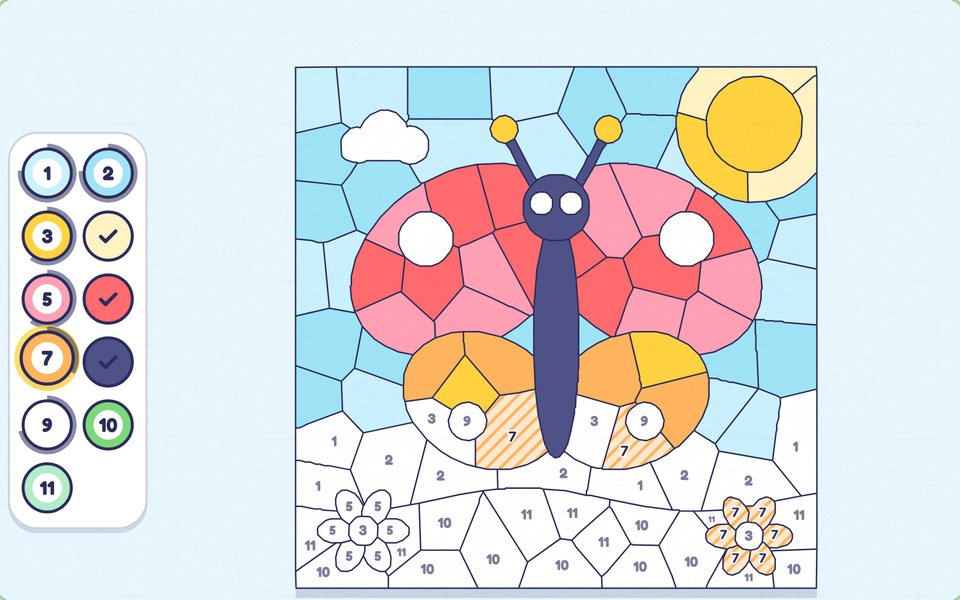
Our color by number adds shades as the pictures grow. On Easy, close shades are joined into one color, so the fish has one blue. On Medium and Hard, the same blue splits into blue, deep blue and light blue. On every printed sheet, the color key names each color and has a box to color in, so it works on a black-and-white printer too.
Where screen games fit
Screen games are one more way to play with color:
- Color by number on this site has nine pictures in three sizes, free in the browser and ready to print. Easy pictures have 34 to 45 big spaces in 6 to 8 colors. Pick a color and its spaces get stripes. A wrong tap never counts against anyone: the number wiggles and the color it needs bounces.
- Dot to dot is about counting, but each picture’s page also prints a coloring page of the finished picture, to color in any colors your child likes.
- Color safari, in the Little Paper app for iPhone and iPad, has eight places and eight color games. Kids find critters of one color in Color hunt, sort food into baskets in Picnic sort and brush color back onto a friend’s clothes in Paint rescue. In Mixing lagoon, kids mix drops of red, yellow, blue and white, with the same recipes as the list above. Pattern bridge has color patterns, Firefly memory has an order of lights to tap back, Flower trail is a bee’s path over one color, and Habitat puzzle is a picture to finish. Nothing is timed, and Hint helps in small steps. The first visit to each place is free. More about Color safari.
- Coloring book, also in the app, has 48 pictures and twelve paint drops. Besides free coloring, Copy the colors asks your child to paint a picture to match a little card, and Color by number matches numbers to colors. The first pack is free.
If colors seem hard
Children learn colors at different speeds. Sometimes, though, colors are hard to tell apart. The National Eye Institute’s page on color blindness says it’s much more common in men than in women, and that the most common type makes red and green hard to tell apart. It suggests getting a child’s eyes tested if color blindness runs in the family or if they seem to struggle with learning colors. Your child’s doctor or eye doctor can help.
Meanwhile, give colors other clues: “the red apple”, “the green leaf”. In Color safari, a switch in Grown-ups called Color shapes marks every color with its own shape.
For more, see our screen time plan and our dot to dot guide.