A maze is one of the easiest things to hand a child: a sheet of paper, a crayon, a way in and a way out. This guide covers how to pick a maze that fits your child, a few tips for small hands, and how to print free mazes from this site, each with its answer.
Pick a size for each age
Three things make a maze harder: how big it is, how often the path splits, and how many dead ends lead nowhere. A maze for a 4-year-old should have a short way through and only a few places to choose. A maze for an 8-year-old can have dead ends all over the page.
The mazes on this site come in three sizes:
- Easy: 6 by 5 squares. The way through is short and splits only two or three times, with two to four dead ends. A good size for about age 4, or for any child’s first maze.
- Medium: 9 by 7 squares. More turns and six to ten dead ends. Most 5- and 6-year-olds are comfortable here.
- Hard: 14 by 9 squares. The way through is long, and there are 15 or more dead ends to wander into. Made for confident 7- and 8-year-olds.
The ages are only a starting point. If your child keeps crossing the walls or gives up quickly, try a smaller size. If they finish without stopping to look, go up one. Going back down is fine too. A tired child at the end of the day may enjoy an easy maze more than a hard one.
Tips for little hands
Mazes ask small hands to stay between two lines, which is harder than it looks. A few things help:
- Use a chunky crayon or a soft pencil. Thick crayons are easier for 4-year-olds to hold. A pencil line can be rubbed out, which takes the worry out of a wrong turn.
- Tape the sheet to the table. Paper that slides around makes the lines wobble. Two pieces of tape fix it.
- Trace with a finger first. Let your child run a finger along the path before drawing it. On paper, the finger can go back and try again for free.
- Look before drawing. Ask “Which way do you think goes to the star?” and let them point. Stopping to look at each split is most of the skill.
- Try it backward. Some children find it easier to start at the star and work back to the start. It’s not cheating, just another way to look at the same maze.
- Make dead ends fun. In our mazes, treats hide in the dead ends. On paper, your child can draw a tiny star at each dead end they find.
- Use it again. Slip the sheet into a clear plastic sleeve and use a dry-erase marker. Wipe it clean and the maze is ready for the next turn.
- Stop while it’s fun. Two or three mazes is plenty for a young child. It’s better to stop when they ask for one more.
How to print mazes from this site
Every maze page on this site has mazes ready to print:
- Open Mazes, or one of the place pages: garden, ocean, snow or space.
- Scroll down to Mazes to print. There are three mazes, one Easy, one Medium and one Hard.
- Press Print under the maze you want. Press Answer to print its solution on a sheet of its own.
The four place pages have three mazes each, so there are 12 mazes with answers in all. Each one fits on a single page of A4 or US Letter paper. Wide mazes are turned on their side so they fill a portrait page. If your printer cuts off an edge, try the scale or “fit to page” setting in the print window.
The printer button above the game prints whatever maze is on screen, with Doodle at the way in. The mazes on screen never run out, so your child can play a few, then print the next one to take to the table. Every maze is made from a number, so the same maze comes back each time, on screen and on paper. Two children can do the same maze and compare their paths.
Four places to explore
Each maze happens somewhere, and each place has its own walls and its own treats:
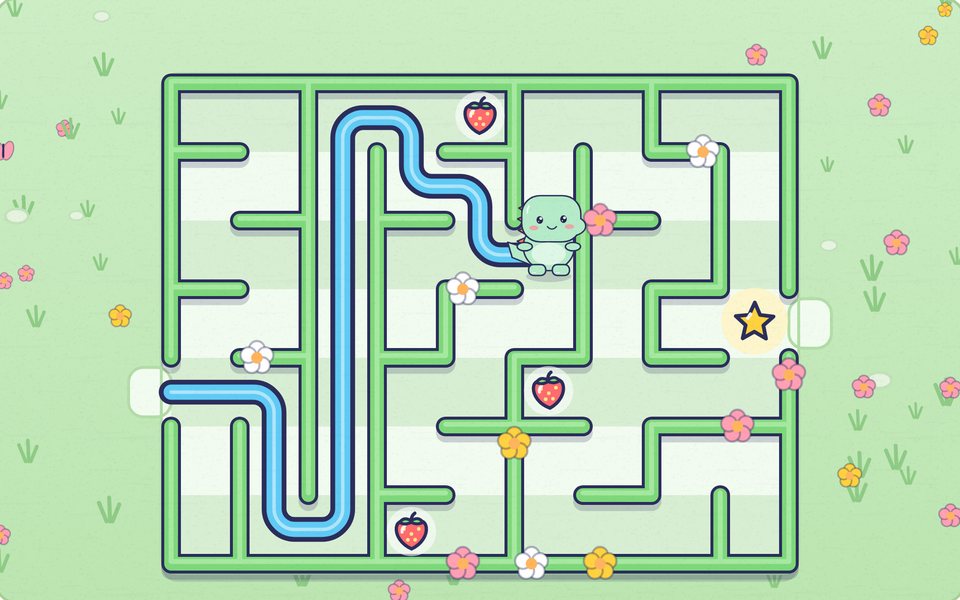
- Garden. Green hedges with flowers growing on top. Strawberries hide in the dead ends, and butterflies flit around.
- Ocean. Pink coral walls on the sandy sea floor. Shells wait in the dead ends, with bubbles and seaweed all around.
- Snow. Shiny ice walls with fresh snow on top. Doodle wears his scarf, and presents are tucked into the dead ends.
- Space. Glowing blue walls across the night sky, little ringed planets in the dead ends and stars twinkling all around.
Each place page also has a true fact to share, from hedge mazes hundreds of years old to the tiny animals that build coral.
Playing on screen
The same mazes play in the browser, free, with no ads and no sign-up. Your child puts a finger on Doodle and draws the way. Walls just stop him, so there are no wrong moves. To take a step back, they walk back over their line.
Young children often find dragging hard, so there are other ways to play. Tapping a spot a few steps ahead makes Doodle walk there. On a keyboard, the arrow keys move him from turn to turn. The light bulb button shows the next few steps, and on Easy, Doodle shows the way by himself if your child waits. Finished mazes and treats are saved only in that browser, on that device.
Where to go next
If your child likes mazes, try a dot to dot: it’s another puzzle you solve with a pencil, and it turns into a picture. Our guide to dot to dot and counting by 2s, 5s and 10s explains how to pick one. For days when you’re thinking about screens in general, our screen time plan shows where printed puzzles fit in.
In the Little Paper app for iPhone and iPad, Drawbridge trail builds on the same idea: kids draw a road, then watch a rolling seed follow it home to its nest.