A dot to dot is counting with a pencil. Your child finds the next number, draws a line to it and keeps going until a picture appears. The fun part is that the same picture can be counted in different ways. Number the dots by 1s for a first try, then by 2s, 5s or 10s, or with the letters of the alphabet. This guide shows how to pick a dot to dot that fits your child, and how to use the free dot to dots on this site for each way of counting.
Start with the right number of dots
The number of dots matters more than the picture. A child who counts to 10 with confidence will enjoy a 10-dot star. A 28-dot dinosaur might feel like a wall of numbers. Our 12 pictures come in three levels:
- Easy, up to 12 dots. The star (10 dots), the house (11), the heart (12) and the fish (12). Good for about age 4.
- Medium, 13 to 24 dots. The sailboat (13), the rocket (15), the pumpkin (17), the cat (21) and the butterfly (24). For most 5- and 6-year-olds.
- Hard, 25 dots or more. The whale and the unicorn (25 each) and the dinosaur (28). For ages 7 and 8.
If your child is still learning the numbers past 10, an Easy picture is the place to start, whatever their age.
Counting by 1s
Counting by ones is the classic dot to dot, and a few habits make it go smoothly:
- Say each number out loud before drawing to it. It keeps the counting and the drawing together.
- Find the dot first, then draw. Put a finger on the next dot, then bring the crayon over. Lines drawn while still searching tend to wander.
- Watch for look-alike numbers. 12 and 21, or 16 and 61, are easy to mix up. Reading the number aloud usually catches it.
- Finish the loop. Every picture on this site ends by joining the last dot back to the first one.
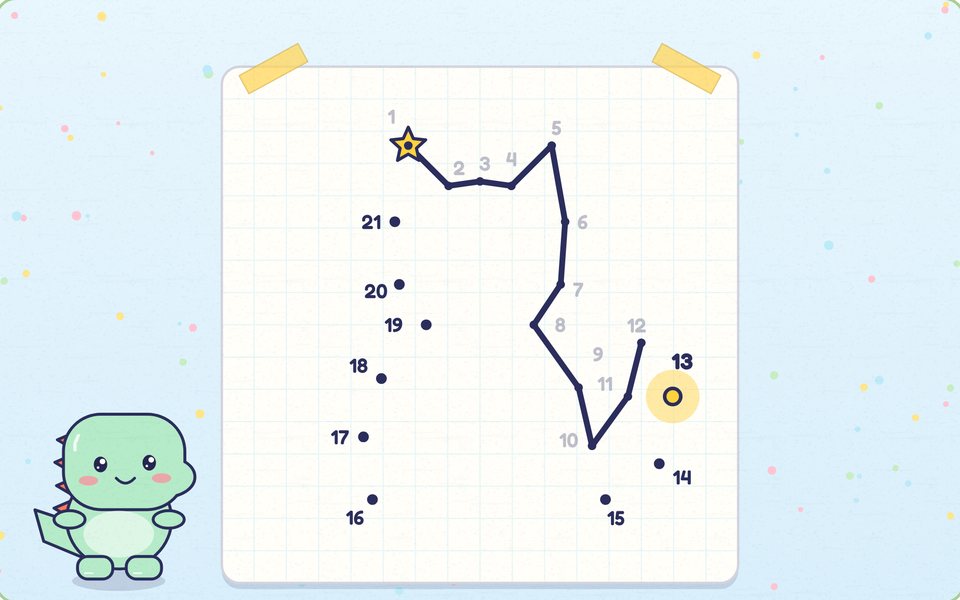
On screen, dot 1 wears a yellow star so it’s easy to find. The next dot glows, and a wrong dot just wiggles. After a few tries, the next dot glows brighter and Doodle points to it.
Skip counting: 2s, 5s and 10s
Skip counting means counting in jumps: 2, 4, 6, or 5, 10, 15, or 10, 20, 30. A dot to dot is a friendly place to try it, because the picture still comes out, so a mistake is easy to see.
In our game, the start card has a row of ways to count: 1 2, 2 4, 5 10, 10 20 and A B. Pick one, and the same dots get new numbers. The 10-dot star becomes 2 to 20 by twos, 5 to 50 by fives, or 10 to 100 by tens. The 28-dot dinosaur goes all the way to 280 by tens.
Some ideas that help:
- Try 10s first. Counting by tens sounds like counting 1 to 10 with a zero on the end, so many children find it the easiest jump.
- Point out the patterns. By 10s, every number ends in 0. By 5s, the numbers end in 5, then 0, then 5 again. By 2s, the last digits go 2, 4, 6, 8, 0 and start over. Once a child sees the pattern, the next number is easier to guess.
- Use hands. One hand is five fingers, two hands are ten. Holding up a hand for each jump makes counting by 5s and 10s something to see.
- Whisper the numbers in between. For 2s, say “one” quietly and “TWO” out loud, then “three” quietly and “FOUR” out loud. The jumps become a rhythm.
- Keep a number chart nearby. A hundred chart, or a strip of paper with the numbers written out, is a fine thing to check. Looking up the next number is still counting.
- Start small. Try skip counting on an Easy picture first. A 10-dot star by tens is a short, satisfying first try.
A to Z
The A B choice puts letters on the dots, so your child joins the alphabet in order. It works on any picture with 26 dots or fewer, which is all of them except the 28-dot dinosaur. Singing the alphabet song while drawing is allowed, and it helps.
How to print
Every dot to dot on this site prints on A4 or US Letter paper, in three ways:
- Each picture’s page has three sheets to print. There’s the dot to dot numbered from 1, then another way to count it, and a coloring page of the finished picture. The second sheet uses letters where the picture fits, and counting by 2s for the dinosaur.
- The printer button above the game prints the picture on screen, numbered the way you picked on the start card. To print the star counted by tens, choose 10 20 and the star, then press the printer button.
- The Dot to dot page prints one picture from each level, the star, the rocket and the whale, each with its coloring page.
Printed sheets are handy for the table, the waiting room or a long car trip. A clear plastic sleeve and a dry-erase marker let your child do the same sheet again with a different way of counting.
After the last dot
On screen, when the last dot joins the first, your child taps the picture to color it in, then taps again to see it move. The fish swims, the rocket flies and the pumpkin hops. On paper, the coloring page is the reward. Either way, it’s a nice moment to ask “What did you think it would be?” Many children guess before the picture is done.
If your child likes matching numbers, try Color by number. Each space has a number, and each number has its own color. Its nine pictures come in three sizes, and they print with their color key. For more puzzles with a pencil, see our guide to printable mazes.