
A cat is a good first animal to draw, because most of it is made of shapes children already know: a circle for the head, two triangles for the ears and a bell shape for the body. This guide shows how to draw a cat for kids in six steps. There’s also a face-only version for 4-year-olds, real cat coats to copy, and two more cats to try once the first one feels easy. Each step’s picture shows the new part in color with a yellow glow, and everything drawn earlier is pale.
Before you start
You need paper, a pencil and something to color with. A dark crayon or marker for going over the lines at the end makes the cat stand out.
Warm up with the three shapes inside this cat: a circle, a triangle and a U. Draw them together on scrap paper, big and small. If the triangles come out rounded, that’s usual at 4 or 5. A table of typical ages from Somerset NHS Foundation Trust’s children’s therapy service puts copying a circle at about 3 years old, a square at about 4½ and a triangle at about 5¼. Children vary by months either way, and a cat with round ears is still a cat.
Six steps to draw a cat
Step 1: a circle for the head
Draw a big circle in the top half of the page, a little to the left. It can be a bit wider than it is tall, like a bun. Leave room below it for the body and on the right for the tail.

Step 2: two pointy ears
On top of the head, draw an upside-down V on each side, like two party hats tipped outward. Start each ear on the circle’s line and end it on the line, so nothing crosses the face. Then draw a smaller triangle inside each ear, to color pink later.

Step 3: a bell-shaped body
From under the chin, draw two lines that curve outward as they go down, and join them with a flat bottom. The body looks like a bell or a pear, narrow at the top and wide at the bottom. That’s the shape of a cat sitting down.

Step 4: legs and paws
Down the middle of the body, draw two long U shapes side by side for the front legs. Their round bottoms are the front paws. Then add a flat oval at each bottom corner of the body for the back feet.

Step 5: a curly tail
From the side of the body near the bottom, draw a thick tail that sweeps out and curls up at the end, like a hook. Use two lines side by side and round off the tip where they meet. Start both lines at the body, so the tail looks attached.
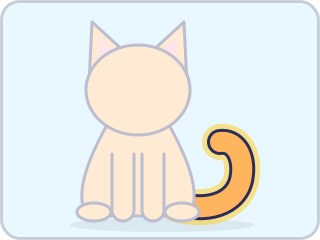
Step 6: a face and whiskers
Put two big eyes in the middle of the head and leave a tiny white dot in each, so they shine. Below them, draw a small upside-down triangle for the nose, and under the nose a mouth like a little w. Add three whiskers on each side, starting inside the face and reaching past its edge, and two pink cheeks if you like. Then color your cat in.
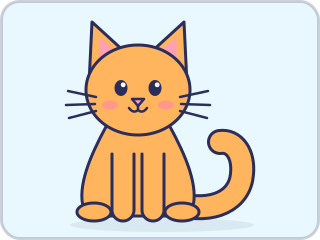
Just the face, for little ones
Six steps can be a lot at 4. Try steps 1, 2 and 6 only: a circle, two ears, then a face with whiskers. That’s a whole cat face, and it’s a good drawing to repeat until it comes easily. It fits on a birthday card, a paper plate mask or a note in a lunchbox.

Tips for little hands
- Trace the head. A cup, a jar lid or a roll of tape makes a neat circle, and saves your child’s patience for the fun parts.
- Say the order out loud. “Head, ears, body, legs, tail, face.” Saying it while you draw makes the steps easier to remember, and next time your child can say it to you.
- Turn the paper. Curves like the tail are often easier with the paper turned, so the line comes toward your child’s hand instead of away from it.
- Draw light, then go over it. Sketch in pencil, then trace the lines worth keeping with a crayon or marker. Leftover pencil lines can stay. They look like fur.
- Keep the surprises. A wobbly outline makes a fluffy cat, and a stray line becomes a stripe. Round ears, or six whiskers instead of three, are choices, not mistakes.
- Look at a real cat (ages 7 and 8). With a cat at home, or a photo of one, look together before drawing: where do the ears sit, and how long is the tail next to the body? Then draw it again from what you saw.
Talking about the drawing
What you say when the cat is finished matters too. Two well-known sources for parents give similar advice:
- Ask, don’t guess. PBS KIDS for Parents suggests open questions like “Tell me about…” rather than “What is that?” in seven ways to respond to your child’s creative work. “Tell me about your cat. Does it have a name?” invites a story.
- Notice what they did. The same article prefers specific feedback to a quick “That’s great.” Try “You gave your cat really long whiskers” or “The tail curls all the way around.”
- Let the colors be theirs. ZERO TO THREE, a nonprofit for families with young children, suggests focusing on what children think about their drawing instead of quizzing them, and not getting caught up on whether things are the “right” color (Learning to Write and Draw). A purple cat is a fine cat.
- Let them lead. Help with a step when your child asks, and resist fixing a line yourself. PBS’s advice is to wait to be invited in.
Make it your own
Once the six steps feel easy, change one thing at a time.
Four cat coats to copy
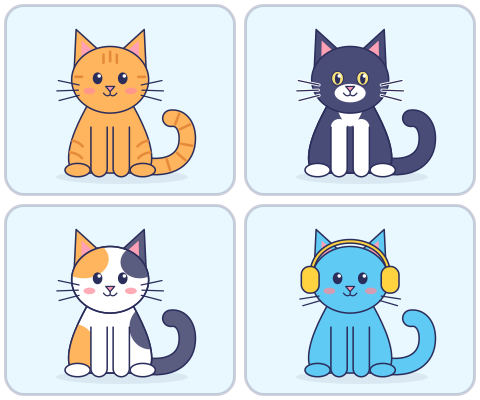
- Ginger tabby (top left). Orange with darker stripes: three short lines on the forehead, curved stripes on the sides and rings around the tail.
- Tuxedo (top right). A dark cat with a white chest, a white patch around the nose and white paws, as if dressed up for a party. Yellow or green eyes show up best on a dark face.
- Calico (bottom left). White with patches of orange and black. Calico cats are almost always female: the gene for orange fur sits on the X chromosome, so a cat needs two X chromosomes to have orange and black patches together. Male calicos are rare, because they need an extra X chromosome: McGill University’s Office for Science and Society puts them at about one in 3,000.
- Kiki (bottom right). The blue kitten from our sports games wears headphones. Draw a curved band over the head and a rounded rectangle on each side, in any color you like.
A cat in a box
Draw the box first: a rectangle with a flap sticking up at each top corner. Then draw the head and ears peeking over the top edge, and two round paws holding on. The box hides the body and tail, so it’s a quick one, and a cat in a box always looks like it’s up to something.

A sleeping cat
Lay a big oval on its side for the body and overlap a circle at one end for the head. Add the ears, then two small curves for closed eyes, like tiny smiles. Wrap a thick tail around the front of the body, and float a few Zs above the head.

A cat on a screen
A cat’s face matches on both sides, so it’s a good one for Mirror magic in the Little Paper app for iPhone and iPad: draw one ear, one eye and three whiskers on one half, and the other half draws itself as you go. For the whole cat, Art studio has a big blank page, an art box of brushes and an undo button for another try at an ear. Its Play button redraws the cat stroke by stroke, in the order your child drew it. Both are always free.
A cat drawn in Art studio is saved in My art, and Paper theater can put it on its little stage to dance.
More cat fun
- The cat dot to dot. Join 21 dots to find a sitting cat with a curly tail, on screen or on paper. It prints from 1 to 21 or from A to U, with a coloring page.
- Doodle tennis. Play a match against Kiki on a beach court.
- How to draw a dinosaur. Six more steps, for a friendly dinosaur like Doodle.


