
Times tables look like a wall of 100 facts, or 144 if school goes up to 12 × 12. They are much less than that. A child who knows what multiplying means, and who learns the easy tables first, has about 21 facts left that really need practice. This guide is a plan for parents: what to teach first, an order that works, the tricks worth knowing and how to practice without a fight. Everything here can be done with a pencil, a few minutes a day and, if you like, the free multiplication game on this site.
When do children learn times tables?
It depends on where you live, and children vary by a year or more either way.
- In England, the national curriculum asks for the 2, 5 and 10 times tables in Year 2 (ages 6 to 7), the 3, 4 and 8 times tables in Year 3, and every table up to 12 × 12 by the end of Year 4 (ages 8 to 9).
- In the United States, the Common Core standards put it in Grade 3 (ages 8 to 9): by the end of the year, children should “know from memory all products of two one-digit numbers”.
So most children meet their first tables at 6 or 7 and are expected to know them all at about 9. If yours is younger and curious, counting by 2s, 5s and 10s is the right place to start. If yours is older and stuck, the plan below still works. Start at the first step that isn’t solid yet.
First, what multiplying means
A child who chants “three fours are twelve” without knowing what it means has a rhyme. Before any memorizing, make sure your child can see a multiplication in three ways:
- Equal groups. 3 × 4 is 3 plates with 4 cookies on each.
- Rows. 3 × 4 is 3 rows of 4. Egg boxes, muffin trays, window panes and chocolate bars are all rows.
- Skip counting. 3 × 4 is counting by fours three times: 4, 8, 12.
Use real things for a week: coins, blocks, pasta shapes. Ask “how many rows? How many in each row? How many altogether?” When your child can build 3 × 4 and tell you why it makes 12, they are ready for the facts.
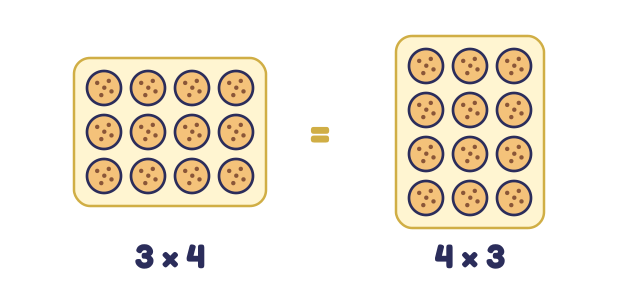
Then turn the tray a quarter turn. Three rows of four become four rows of three, and nothing was added or taken away. That one idea, that 3 × 4 and 4 × 3 are the same fact, cuts the work almost in half. Both curriculums above ask for it by name: England’s Year 2 pupils learn that multiplication “can be done in any order”, and the Common Core’s example is “If 6 × 4 = 24 is known, then 4 × 6 = 24 is also known.”
There are only 21 hard facts
Look at a times table chart up to 10 × 10. It has 100 answers, but most of them are easy:
- The 1 times table is the number itself.
- The 2 times table is doubling, which children know from adding (6 + 6).
- The 10 times table puts a zero on the end.
- The 5 times table ends in 5 or 0, like the minutes on a clock.
Those four tables, across and down, fill 64 of the 100 squares. That leaves a block of 36, and because each fact has a turned-round twin, only 21 of them are different.
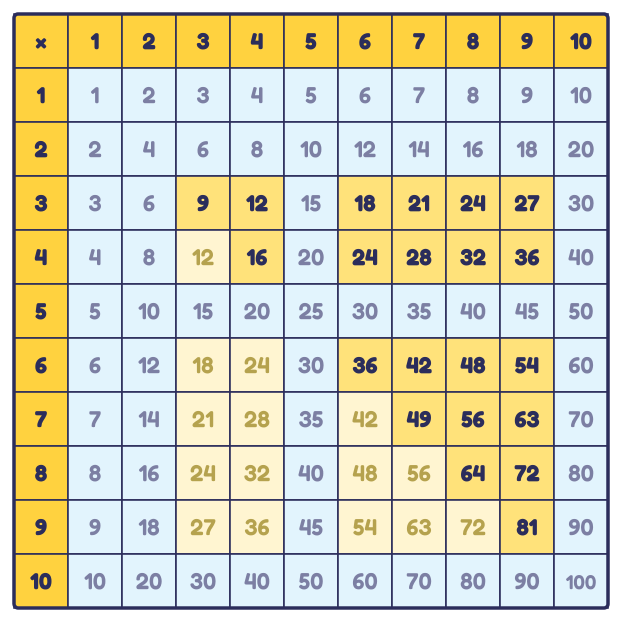
Show your child this chart. “You already know the blue ones. The yellow ones are all we have left” is a much happier start than a page of 100 sums. The multiplication page on this site prints a times table chart up to 12, and a blank one to color in as the facts are learned.
The best order to teach times tables
Don’t go from 1 to 12 in number order. Go from easy to hard, and let each new table lean on one your child already knows:
- 1s, 2s and 10s. Quick wins, and they prove the idea.
- 5s. Half of the 10s: 5 × 6 is half of 60.
- 3s and 4s. The 4s are the 2s doubled: 4 × 7 is double 14.
- 6s. The 3s doubled: 6 × 7 is double 21.
- 9s and 8s. The 9s have a pattern (below). The 8s are the 4s doubled.
- 7s. By now the only new fact in the 7 times table is 7 × 7.
- 11s and 12s, if your child’s school goes that far.
Schools don’t all use the same order. England’s goes 2, 5 and 10, then 3, 4 and 8, then the rest, and its notes for teachers say that “through doubling, they connect the 2, 4 and 8 multiplication tables”. The exact order matters less than the principle: start easy, and link every new table to an old one. Ask your child’s teacher which table the class is on, and practice that one.
Tricks that work, and why
A trick is worth teaching when it is really a piece of math, because then it also helps later. These all are:
- × 4: double, then double again. 4 × 6 is double 6 (12), then double 12 (24).
- × 5: half of × 10. 5 × 8 is half of 80.
- × 6: the 5s and one more. 6 × 7 is 5 × 7 and one more 7: 35 + 7 = 42.
- × 9: ten of them, take one away. 9 × 6 is 60 − 6 = 54.
- × 11 up to 9: the digit twice. 11 × 4 is 44. This stops working at 11 × 10.
- × 12: the 10s and the 2s. 12 × 6 is 60 + 12 = 72.
- A neighbor you know. Stuck on 7 × 8? 7 × 7 is 49, and one more 7 makes 56.
The 9 times table has a pattern worth a minute of looking. As you go down the table, the tens go up by one and the ones go down by one, and the two digits of every answer add up to 9.
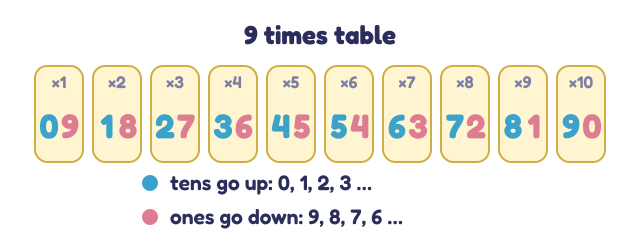
There’s a finger version too. Hold up ten fingers and fold down the one that matches the number you are multiplying by 9. For 9 × 4, fold down the fourth finger: three fingers stand to its left and six to its right, and the answer is 36.
One rhyme earns its place: “five, six, seven, eight” gives 56 = 7 × 8, the fact most children find hardest.
Five minutes a day beats an hour on Sunday
Knowing a fact today is not the same as knowing it next month. Two findings about memory are useful here. The US Institute of Education Sciences’ practice guide Organizing Instruction and Study to Improve Student Learning recommends spacing learning over time, and rates the evidence for using quizzes to bring learned material back as strong. In plain words: short and often, and ask, don’t just tell.
- Keep it to about five minutes. In the car, at breakfast, on the walk to school. Stop while it’s still going well.
- Work on two or three new facts at a time, mixed with ones your child already knows, so most answers come out right.
- Mix old tables in. A table left alone for three weeks fades. Yesterday’s facts first, then today’s.
- Ask both ways round, and backwards. 6 × 7, then 7 × 6, then “what times 7 makes 42?”, then 42 ÷ 7. They’re one fact wearing four coats.
- Say the whole fact, “six sevens are forty-two”, not just “42”. The sentence is what sticks.
- Let your child quiz you, and get one wrong on purpose. Catching your mistake is practice too.
What about speed and timed tests?
Schools do test recall. In England, children in Year 4 take a multiplication tables check: 25 questions on screen with 6 seconds for each, on tables up to 12 × 12. The Department for Education says there is no pass mark.
Not everyone thinks a clock helps. In Fluency Without Fear (2015), Stanford’s Jo Boaler argues that timed tests are where math anxiety starts for many children, and that facts are better learned through number sense, strategies and games than through drills. Her paper makes a case more than it settles the question, but the practical advice is easy to agree with: at home, understanding comes first and speed comes later.
A sensible middle path:
- No timer while a table is new. A child working out 6 × 7 from 5 × 7 is doing exactly the right thing.
- Speed grows by itself with spaced practice. Fast recall is where this ends up; you don’t have to train it with a stopwatch.
- If a timed check is coming at school, practice against the clock in the last few weeks only, and call it a game of beating your own score.
- If your child freezes or gets upset, drop the clock and go back to rows and tricks for a while.
When a fact just won’t stick
Every child has a few. Don’t repeat the fact louder. Change how it is stored:
- Pick one stubborn fact a week and put it on the fridge.
- Tie it to a fact that’s solid. 8 × 7 is double 4 × 7, so double 28.
- Draw it. Eight rows of seven dots, split into 5 rows and 3 rows: 35 + 21.
- Find it on the chart and color its square, and its twin’s.
- Use it. “Seven days in a week. How many days in 8 weeks?”
Practice on this site
The multiplication game follows the order above: 1s, 2s, 10s and 5s, then 3s, 4s and 6s, then 9s, 8s and 7s, and 11s and 12s at the end. Each new table has a level of its own, followed by a level that mixes it with the tables before. A level is ten questions with three answers to pick from, and every right answer feeds a monster a cookie.
- No clock and no lives. A miss only wiggles, and your child picks again.
- A light bulb shows the rows. 4 × 6 becomes 4 rows of 6 cookies to count. Bigger facts become a skip count.
- All 40 levels are open, so you can jump to the table your child’s class is on.
- It prints. A times table chart from 1 to 12, a blank chart, and three practice sheets with answers.
The division game uses the same order, level for level, so 5 × 6 and 30 ÷ 5 can be learned in the same week. For a younger child who isn’t ready for tables, the dot to dot pictures can be joined by 2s, 5s or 10s, which is skip counting with a crayon; our dot to dot guide explains how. And all four math games are free, with no ads and no sign-up.
Quick answers
Which times table should we learn first? The 2s, then the 10s and the 5s. They’re the easiest and they come up most in daily life.
Should my child learn up to 10 or up to 12? Follow the school. England’s curriculum goes to 12 × 12, and many others stop at 10 × 10 (the Common Core asks for products of two one-digit numbers). The 11s and 12s are easy to add once the rest is known.
How long does it take? For most children, a few months of short daily practice, spread across two or three school years. One table every week or two is a comfortable pace, with old tables kept in the mix.
My child counts on fingers. Is that bad? No. Counting and working things out are how facts are built. Fingers fade away as the answers start coming from memory.


